
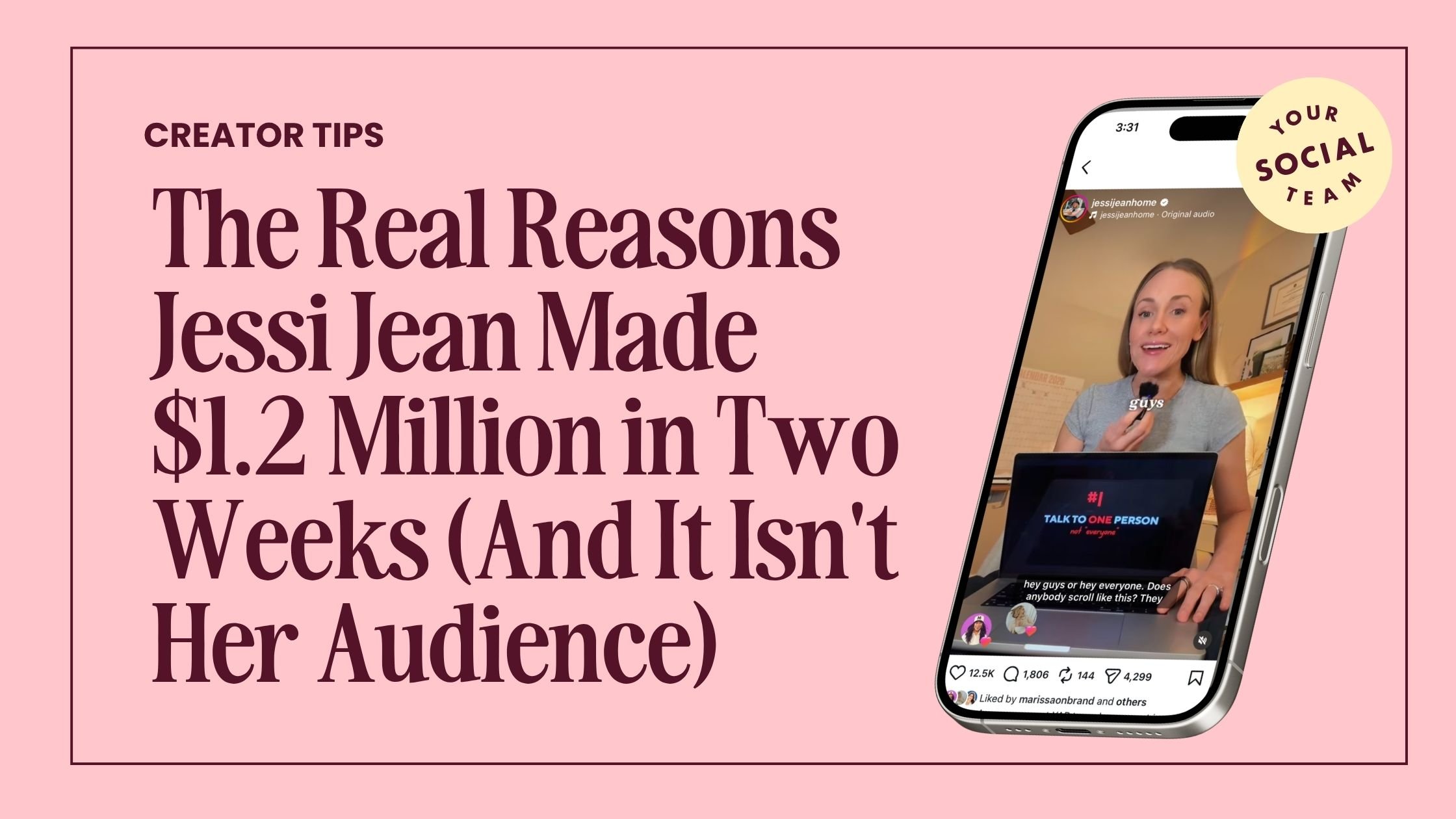
If you've been online lately, you've seen the number. Jessi Jean (a content creator who grew her account with talking head reels, or what people are calling yapping videos, and went from zero to 400K followers in about five months) ran something called the Yap On Camera Challenge and reportedly pulled in $1.2 million. From a $297 product. In under two weeks.
Everyone has a take. The breakdowns flooding your feed say it worked because she's relatable, she caught the "yapping" wave, she built trust, she has a big audience. All true. All also kind of surface level. Most of those takes stop exactly where it gets interesting.
So this is the deeper version. The parts most people skated past... sorted into the two piles that actually matter. Because there are two completely different things going on in this launch, and lumping them together is why people walk away either green with envy or copying the wrong moves entirely.
Pile one: what was hers alone (the stuff you genuinely can't replicate, so stop trying). Pile two: what anyone can steal (the mechanics that have nothing to do with being Jessi Jean).
about the $1.2M…
The $1.2 million is Jessi's own figure, shared on social media. We have no reason to doubt it, but it's worth saying out loud: this number is almost certainly gross. Before platform fees, before refunds, before team and tool costs, and before taxes. The real take home is lower. It always is.
The people who get something useful out of studying other people's launches are the ones who look past the headline and ask what the structure was. So that's what we're doing.
One: What Was Unique to Her
🤯 The product was the proof
Almost nobody names this one. Jessi was selling "how to talk to camera and grow fast," and her entire existence was the demonstration. Zero to 400K in five months is the curriculum. Every video she posted to sell the challenge was a live performance of the exact skill she was charging you to learn.
There was no gap between the claim and the evidence. She didn't have to convince you she could do the thing... you watched her do it in the same reel where she pitched it. That kind of congruence is wildly persuasive, and it's mostly not available on command. If what you sell isn't the literal thing your own growth story proves, you can't manufacture this. Admire it, but don't beat yourself up for not having it.
🤯 She launched at the peak of her own wave
The timing underneath the timing: Jessi sold this at the peak of her growth curve, not after it. The algorithm was actively pushing her in front of brand new people the same week she was selling to them. Most of us launch after the spike, once reach has cooled and we're back to talking to the same 2,000 loyal people.
You can't schedule a viral moment. You can't decide "I'll be the algorithm's favorite this week." That window opened for her, and she had something ready to sell when it did (which is the one learnable piece here, and we'll come back to it).
🤯 The newness factor
She was the new, exciting thing. There's a particular energy the internet reserves for a creator who's clearly happening right now... people want to get in early, be part of the origin story, buy from her before she's everywhere. That novelty is potent and completley non renewable. You get it once, if you get it at all, and she spent hers well. If you've been at this for years, you don't have this lever, and no amount of strategy gets it back.
Two: What Anyone Can Use
🔥 Run a challenge, not a course
This structural move has nothing to do with follower count. Jessi didn't drop a course and let it collect dust on a sales page. She ran a challenge (a posting sprint with a hard start date, a cohort starting together, and doors that closed).
That one decision changes the whole feel. A course is something you buy and feel mildly guilty about not opening. A challenge is an event... there's urgency, a deadline, a group all starting at once, and that "everybody's doing this, get in before it closes" pull. People weren't buying a PDF. They were buying into a moment with a countdown on it. You can build that at any audience size.
🔥 Make the homework the marketing
Watch how clean this is. The challenge ran on a public hashtag, so every person who paid was posting their own videos (tagged, into the same algorithm) during the exact window the thing was being sold. Her customers' homework was her advertising. A flood of fresh, on brand content pointing back at the offer, made for free by the buyers, while the offer was live. Any challenge built around posting is structurally a content machine. The action that completes it is the action that sells the next person. That's a flywheel you can design on purpose, today, with the audience you already have.
🔥 Sell the feeling, not the feature
Notice what Jessi didn't lead with. Not "learn video editing." Not "master your hook." She led with the feeling... kill the inner cringe, stop hiding, stop overthinking every Reel.
That's an identity pitch, not a tactics pitch, and it reaches a much bigger audience. The number of people who want to "learn a content skill" is relatively small. The number who are quietly terrified of being perceived, who overthink themselves into paralysis every time they open the app... that's basically everyone. She named the thing actually stopping people, and the thing stopping them was never the editing. You can do this with any offer: find the fear underneath the feature and speak to that instead.
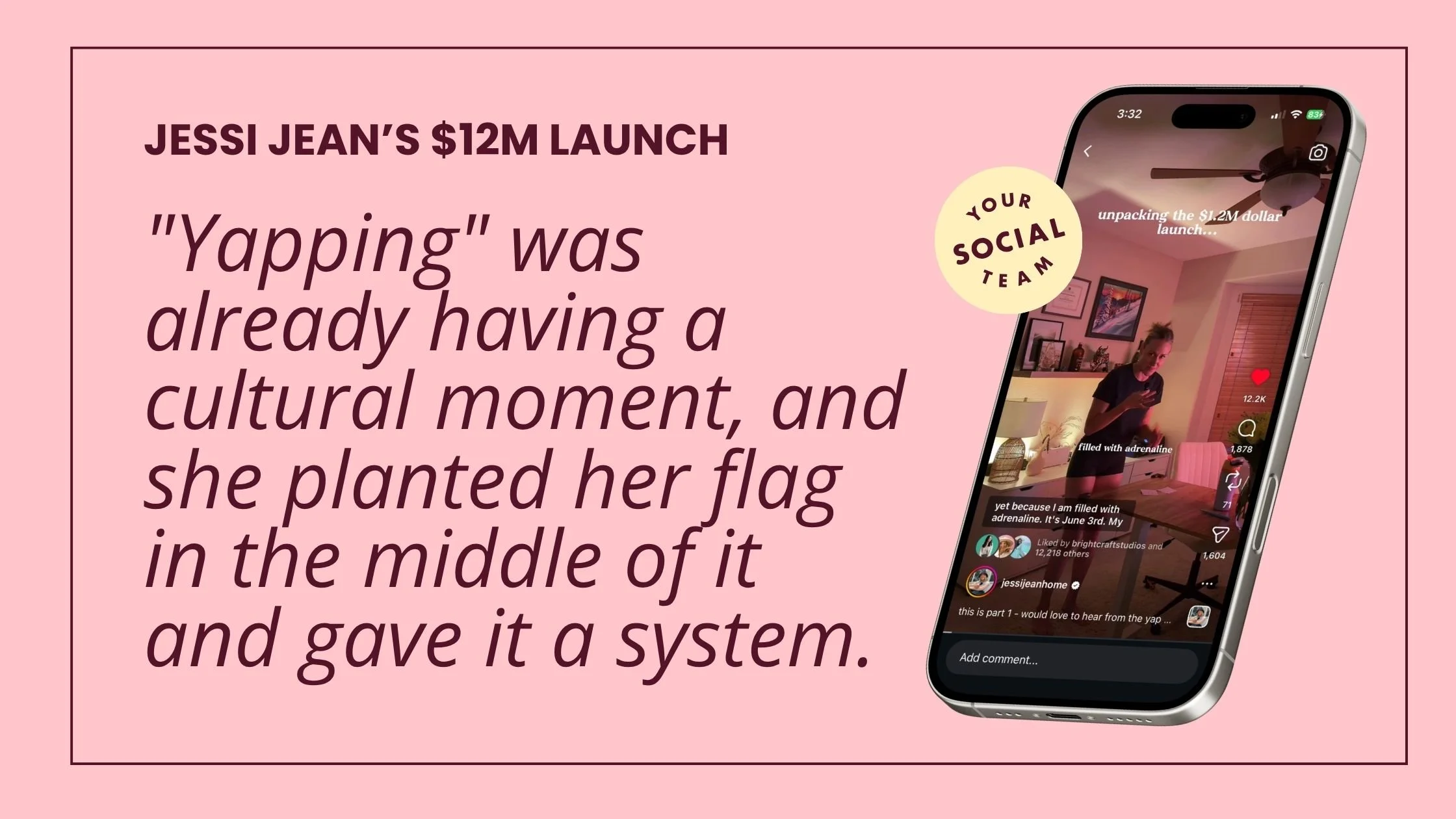
"Yapping" was already having a cultural moment. Jessi Jean planted her flag in the middle of it and gave it a system.
🔥 Attach to a wave that already exists
Jessi didn't invent a category and spend a year teaching people why it mattered. "Yapping" was already having a cultural moment, and she planted her flag in the middle of it and gave it a system. Borrowing existing momentum early is dramatically cheaper than manufacturing your own. You don't need to be the trend... you need to hitch your offer to one that's already moving.
This is also the learnable piece of the timing advantage: you can't schedule going viral, but you can stay close enough to live trends that you always have something ready when a window opens.
🔥 The power of showing up… and this is a bit of a cliche, but humor me: show your authentic self.
Jessi Jean has said she doesn't really believe in funnels. She believes in being the loudest, kindest version of herself in public. Which is a lovely way to put it. But that’s kind of a funnel, when you look at it.
A low friction front end offer, a community experience, a public proof generating mechanism, and a back catalog of higher priced products waiting on the other side.
Not doing funnels is the positioning that makes the whole thing feel like a movement instead of a sales process.
That's not a criticism. If anything, it’s a big compliment and a bit of healthy jealousy, because she absolutely nailed it! I wish all the rest of us amazing women entrepreneurs were nailing it like her and conquering the world. But while we work on this, it’s so wonderful and inspirational to see someone like her, like us, doing it!
But Where Does That Leave You?
The reasons for her success everyone's quoting and telling us we can all copy are her audience, her growth story, her timing.
But these are mostly the part you can’t replicate. They are unique to her personality, skills, talents, strategy and timing. Plus a bit of it is the stars aligning.
But the reasons her launch converted (and I used “converted” here as the understatement of the year!), which are the challenge format, the homework as marketing, the hook, the borrowed wave, the non-funnel funnel, is something we can all learn from.
Speaking of catching a trend at the right moment, let’s talk about your Instagram content…
The reason most people miss the wave isn't lack of strategy. It's the overthinking.
You open the Instagram app, freeze on what to post, scroll for a while, talk yourself out of it, and close it again. Who never, right?
So I took that part off your plate.
Each week I hand you the trends actually worth jumping on, already designed in Canva for you and ready to customize and post in minutes.
So you're never blindly copying something that doesn't fit you.
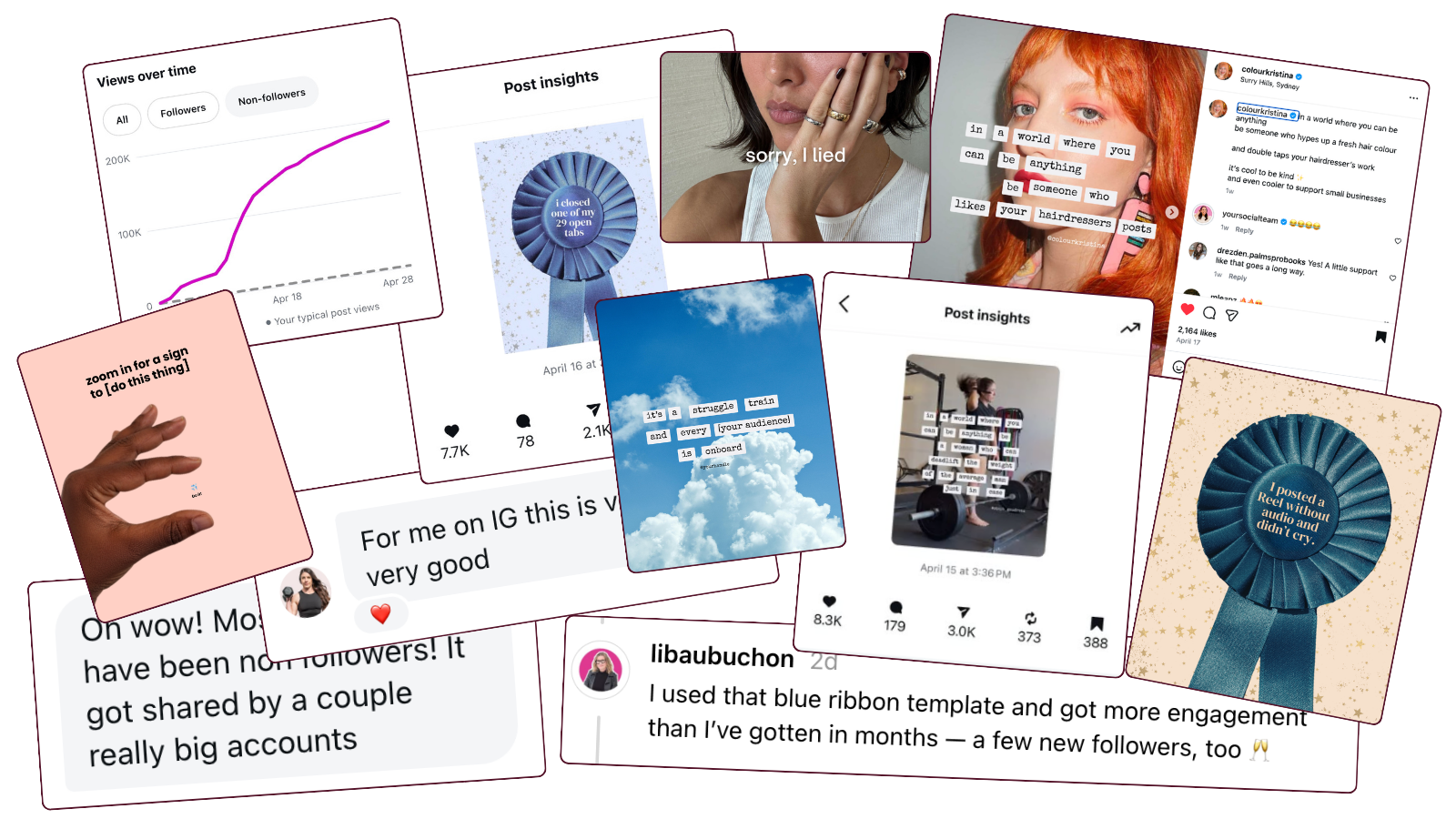
*results not typical
Trends are not being like everyone else. Trends is being part of the conversation and jumping in early is the difference between being the Instagram account that gets saved and the one who is doing the saving. 🤩

Photo: KVC Photography
About Manu Muraro
Manu Muraro is the founder of Your Social Team, a content marketing brand helping small business owners grow through strategic email marketing and Instagram content.
She’s the creator of Your Template Club, one of the first Canva template subscriptions designed for Instagram, and the founder of Your Inbox Team, a weekly email marketing membership that helps entrepreneurs send consistent, high-converting emails in under 15 minutes.
Manu is also the creator of The Reelies Awards, the first award show celebrating Small Business Owners and Creators’ creativity and originality in Instagram Reels.
A former creative strategist at Cartoon Network, Manu brings award-winning experience to everything she creates — from viral Reels to done-for-you content that saves time and drives results.
👉 Follow Manu at Your Social Team on Instagram